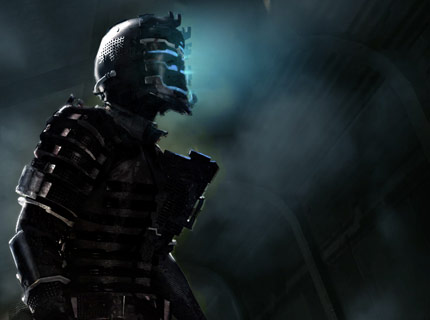
Sunday, 31 March 2013

Revisiting Assassin’s Creed II - A Big Ol’ Slice of Heaven

A cut above the rest?

In his seminal masterpiece “The Civilisation of the Renaissance in Italy”, 19th Century historian Jacob Burckhardt says of that time period:

“An objective treatment and consideration of the state and of all the things of this world became possible.The subjective side...asserted itself with corresponding emphasis; man became a spiritual individual and recognised himself as such.”

The reader can see much of this Renaissance Representation reflected in Ubisoft’s Assassin’s Creed II - here we have characters critiquing the state, putting forward their own plans, propositions. At the same time, the game exhibits the flamboyant showmanship of the Renaissance through festivals, carnivale, extravagant clothing, architecture and art. 

There is, however, one key difference between Burkhardt’s work and Ubisoft’s game - Assassin’s Creed II is actually quite a bit of fun, whereas Civilisation makes me want to stick a hidden blade in my brain via nostril. 

That said, the game deserves more than just to be labeled ‘a bit of fun’. Actually, bluntly put, ACII makes the original 'Creed look like a blueprint for this sequel. In fact, I’m going to lay my terribly orthodox opinions down on the table and proclaim Assassin’s Creed II as the best the franchise has offered to date. 

Everything you can do...

At a first glance, this may seem a bold claim. Although it’s true that ACII might briefly look much like the same action-conspiracy-laden-sandbox-parkour-stabfest-adventure as before, now just a bit dressed up to fit the 15thC, the lightest of scrapings reveals just how much the developers have responded to criticism of the original game. Actually, it’s pretty much impossible to discuss the game without frequently referring to the first game’s inadequacies  - every element of the original has been somehow tweaked, improved, re-thought or else redacted for the sequel. 

This list of improvements, while not actually endless, certainly comes out longer than the dialogue in your average Michael Bay flick. ACI’s singular, bland enemy type has been flattened under the variety of enemies endowed with a superfluity of weapons - daggers, hammers, axes, spears. Fists are now a viable option in combat. The unwavering sun that one shone on Damascus and Jerusalem has been switched for a timed day/night cycle. 

Ezio, the game’s new protagonist, is both nimble and acrobatic (and makes his predecessor Altair look positively arthritic). This, among other things, entails he doesn’t have to be on a level plane with his target to exact swift murdery goodness. Nope: The player can now dispatch his target from rooftops, ledges, even while napping in a stray bale of hay.

Further, in my surveyal of Altair’s adventures I made the point - somewhat vehemently - that there the player is expected to work with the tools  given or else taste pixellated backhand. Here, you’re given far more slack on how you want to interact with the world. Ezio is free and encouraged to customise and upgrade his weapons, outfits and so forth. 

This is a game that wants you to enjoy yourself right up to the end of the 20 hours or so of story, while AC1 was the equivalent of a blind date that keeps yawning and checking her watch, wondering when you’re going to pluck up the nerve to excuse yourself and leave.

Alright, I hear you: less social life, more escapism.

Where there’s an alteration, there’s an addition - too many to fully list, though one of the standout inclusions that can't be overlooked are the ‘Assassin’s Tomb’ missions: six entirely optional, linear levels that vary from sewer to palace, and require the player to exercise as much mental agility as dexterity. I say optional, you’d be a fool to overlook them.
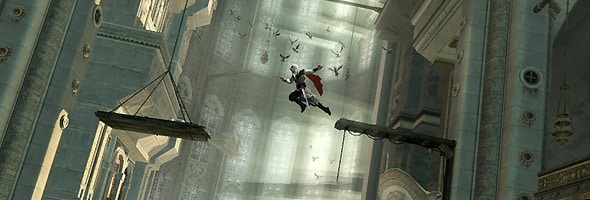
Tomb With a View?


Never Cross the Streams (unless developing games)

These alterations and add-ons are all well and good, and make for a much more enjoyable romp. Assassin’s Creed II’s highpoint (pun!), though, isn’t in these micro-improvements; rather it's in the way all these individual elements (let’s for convenience’s sake categorise them into setting, narrative and gameplay) are woven together, not tacked alongside each other.

‘Nay!’ cries the objector. ‘Surely gameplay always has a place in the narrative of a games, and that story always has to be set within a place? What makes this game so special?’ True, uncommonly literate respondent - almost all games will connect story, place and gameplay together to some extent. Some, however do it better than others, and some are as accomplished at it as I am at football.

(My career at that particular sport slid from defender to goalkeeper to goalpost, in case you’re wondering).

Particular examples of games that flail at this element merging are Tony Hawk’s Pro Skater (I can’t believe those pesky COMBO letters have escaped again!); Call of Duty (“Why is the player suddenly in this location?” “Why not? It looks pretty”), and, of course, the original Assassin’s Creed, where missions were unashamedly added on after the narrative was already finished. 

Conversely, in Assassin’s Creed II, narrative, setting and gameplay are coiled into a single whole to such a degree that it would be impossible to parse them apart. 

Bear with me - it's necessary to explain this bit properly. 

Take narrative and setting alone, first of all.  Interesting historical characters, from the dubious Pazzi to the downright nasty Borgia, as well as the surprisingly comic Da Vinci himself, have central parts to play within the plot. Staples of the Renaissance - religion, conspiracy, self-expression - also happen to be themes that bleed into the Assassin’s series as a whole. 

We see all these things, additionally, through the lens of our new protagonist, Ezio Auditore, in many ways an archetype of the Renaissance himself. As opposed to Altair’s bland stoicism, we meet Ezio as a loud, sharp, self-absorbed youngster, certainly not Master Assassin (PhD). The series’ new-found sense of humour  is complimented equally by the sharp writing and characterisation as much as the world Ezio himself lives in.

It would, then, be jarring to uproot the plot and plant it in a different place or time period - they're too bound together, which is just as well, because Renaissance Italy sprawls in both of the game’s halves: Florence, Tuscany and Forli, then in the larger labyrinthine Venice (or Venezia, if you want to sound pretentious and make people dislike you more). Real architectural landmarks are realised, when viewed up close with startling detail. I’m not going to say ‘living breathing world’, but It’s a close run thing. Costumes are extravagant, cities bustle with noise and music. 
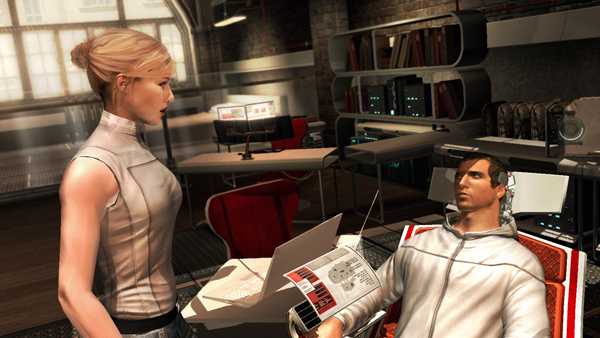
Changes are justified from a narrative standpoint, deepening immersion

These elements of setting and plot then built into the gameplay, not alongside. Missions, to different extents, always have some kind of relevance to the narrative, very rarely existing as obvious time-padding. The ‘Hey Altair, please find my flags and I’ll tell you something about your target’ structure of AC1 is no more; rather, cutscenes and dialogue always frame the basis for what the player does. The gameplay changes noted above, additionally, are justified narratively by the fact that the ever bland Desmond is hooked up to the Animus 2.0. It's another unnecessary yet welcome touch that adds another piece of evidence to the overallpoint.

The developers also use gameplay to emphasise certain points of narrative. To make another bad pun, the merging cuts both ways. Ezio’s first intended assassination, for example. is both emotion-fuelled and sloppy, and forces him to flee his home town and take refuge in his uncle's mansion. The game recognises the player's rustiness and uses it, making the player feels as though his/her actions are in tune with the narrative, not distinct. Desmond’s shorter sequences similarly grow clumsy combat to honed carnage as comes to absorb the skills of his ancestors as the player's skill progresses alongside. 


Needles in a Haystack

It’s this coalescing that was the downfall of the original Assassin’s Creed, but what makes this sequel shine even when the graphics begin to look less than sparkling - which is just as well, because that’s happening as the next generation begins to roll in. The animations that only a few years ago were at worst adequate have become comical.

Don’t believe me? Fast forward to the ‘grueling’ scene of 5:50-6:00 of this walkthrough (disclaimer, which isn’t owned by me)  and see for yourself. Can you not taste the horror of the scene? Me neither

It’s not just in the close-up detail that the game fumbles a bit, either. The grand buildings, as noted, look sublime when being climbed but from a distance look more like cardboard cut-outs than imposing structures. The skyline overall also looks muddied and hazy compared with more recent gaming cityscapes. 

The narrative also suffers from a few blights, the main foible being that story often juts forward years at a time, leaving the player perplexed and often disgruntled. Characters are often disposed of in odd ways, too - Ezio effectively damns his sister to several decades of managing his finances. 

It’s important to realise, however, that most of these flaws arise only because ACII bites off considerably more than ACI ever attempted to chew. These shortcomings, in other words, exist because the game tries to do much more with itself and sets the standard far higher. The vast majority of the time, it succeeds.

Overall, ACII is still a fantastic, incredible, adjectival-topping jaunt into one of the best games that the current generation has to offer. Even when the game becomes as old as Burkhardt’s language, it’ll never be as archaic. 

But why bother waiting that long at all? Get climbing, get running, get stabbing. Go.

If you want to see my opinion of Assassin's Creed the first, go here.
To read about my adventures an an uneducated juvenile, go here.
If you want to read Jacob Burckhardt, go get some sun.


Saturday, 23 March 2013

What Primary School Taught Me: To L and back again


“Good Morniiing Mister Bloggs..”


Whether you called it Primary school, Elementary, Kindergarden or us-kids-sitting-cross-legged-inside-a-shack-somewhere: all of us share a lot of the same memories of our earliest stages of education, mainly because these memories are drawn from largely the same pool.

Most of us, for example, had some variety of flavoured milk at break (I’m team strawberry, personally), we all knew to Never-Ever-Ever tell even your closest allies if there was something tooth-decaying in your lunchbox. Hordes of children kicked the bins and ran from even greater hordes of bees; scores of us attempted to grow little portable patches of cress and often staked bizarre levels of pride in our plant’s vertical progress. 

At the same time, it’s important to recognise each of us have our own pocket of experiences that our opening years of education have given us specifically. So, without any more textual dribbling, allow me to share three lessons Primary school have imparted to me and probably not you:

Lesson One: Hiding under your table is a valid alternative to doing homework

Back at the very start of my Primary school career, I hadn’t done my homework. You read right: try your best to abstain from clapping me in irons. For whatever reason, I hadn’t glued the macaroni to the sugar paper or whatever it was I was supposed to apply my mind to that previous evening. Additionally, I distinctly remember being worried because I hadn’t done well rehearsing the alphabet - or something like that - earlier that day.

If I had told the teacher (a nice lady who we’ll call Mrs X, well rehearsed in the follies of four-year-olds) I would have at worst been given a sentence-long rebuke. Maybe a charge to do it for the next day. As she went round the tables inspecting whatever it was everyone else had done, though, a sterling plan emerged in my muddled head: instead of telling the truth, I could hide. 

But where? 

The answer struck me like a gym-shoe to the face. I eyed Mrs X across the room, bent over and inspecting the handiwork of someone else; I eyed the peers in my group, too transfixed by their own mini-marvels to see anything in their peripheral vision, then decided to act. I edged out my little red chair from the desk slightly, kicked my schoolbag to the side and slithered off my seat and under the table. 

I told you it was sterling. Miraculously, nobody spotted this daring feat among the feet, or else perceived it to be too commonplace to be worth mentioning. 
Plan executed, I clasped the legs of my seat with my little hands, pulled the chair in and waited for Mrs X to nod appreciatively at my group’s pastapieces and move on, at which point I’d slither out, put this blip behind me and resume my travels through the education system.

A couple of minutes passed, and I was getting bored. I counted the shoes around me, fiddled with the straps on the schoolbags, tried to remember if lunch was soon. To a Primary one, lunch is always too far off (although, to a second-year university student, lunch is still always too far off).

I counted my fingers, recited rhymes, played with the velcro on my shiny school shoes. Not long now, I thought, not long now until she- 

“David?”

Slowly, I arched my little neck round, and saw Mrs. X was crouched, looking at me, wondering what on earth I was doing amid all the schoolbags. Her mouth formed a small circle of surprise.

O. That was the letter I kept forgetting...

These guys saved my education. Except Quarrelsome Queen. Nobody likes Quarrelsome Queen.


Lesson Two: You are never ‘Too Young’ to partake in strategic conquests
Some geography is necessary: the entire outside area of my school was essentially a large ‘L’ shape nestled around the building itself. The upper side of the ‘L’ was the area for older students (between Primary 3-7), a big slab of grey tarmac where kids could trade cards, bounce balls and so forth. 

The other line was for the younger ones- a smaller area made of similar stuff where the Primary 1’s and 2’s could gain temporary respite from the trials of learning to pronounce their own names properly.

Now, just beyond that horizontal side of the L was a stretch of grass which sloped up lazily at one end to become a fair-sized knoll.

This patch of elevated turf came to be known by the older students simply as ‘The Hill’. We were a platonic bunch, really. To the bored older ones, ‘The Hill’ - particularly during summer - looked more appealing than back-to-back episodes of Bernard’s Watch. The light breeze would waft the shards of grass about, lazily inviting us to come destroy it with our footballs. Lost lunch money beckoned the adventurers, while other sun-gleaned areas called for the more silver-tongued striplings to make the case why the white colour is a necessity for crayon packs.

In the greatest outrage in the history of Scottish education, for most of our lunchtimes The Hill was decidedly, uncompromisingly, out of bounds. Whether that’s because certain days were allocated for certain year-groups, or it was only certain days of the week all were allowed on at the same time, I don’t really remember. 

This didn’t bother most, who were comfortable enough flailing about or throwing rubber balls hard at walls (and then acting surprised when it came charging back at their faces).

To an elect few, however, The Hill still beckoned, and this same select few strove to meet it. To reach our desire on one of these ‘out of bounds’ days, an elder student would have to navigate through the younger playground - the wrong side of the L all the while avoiding the patrolling sentries that were the Teaching Assistants - in reality, adults trying to make sure no-one had decided they were human agents of the god of war, but to us, nefarious masterminds who wanted children to enjoy themselves as much as Alcatraz inmates.


To successfully travel to to The Hill, then, we had to get strategical. This we did one summer, where a band of us developed several strategies to bypass the staff, get to our grassy destination and play our fill of Ninjas versus Commandos.These ingenious plans included: 

The Pawn - works better for larger parties. Send a pair of unlucky martyrs to get deliberately caught while a larger party sweeps across the other side of the playground. Success chance: moderate.

The Disguise - works better for individuals or younger groups. Crouch and stroll nonchalantly across, pretending, without ever drawing attention to yourself, that you’re a younger child. Last minute dash necessary or Assistants will see you on the grass. Success chance: unlikely.

The Shuffle - this one is a stroke of genius - walk along the wall of the school building, facing the building and keeping your back to everyone behind you. You’ll blend right in and look totally subtle. Success chance: if you try this, you’re an idiot.

Sometimes our stratagems would work, other times we’d get easily caught and marched back to the grey slab. 

By the end of term, we spent so much time on our military-style excursions I wouldn’t have blamed the staff if they wondered whether cane wasn’t actually a pretty swell idea after all.

Still, it was a fun few weeks that educated me greatly in the merits of teamwork and pragmatism, though I probably owe a few apologies to several faculty members, and more than one box of chocolates. Sorry, guys.

Moving swiftly on.


Lesson Three: Each teacher is equipped with at least one eye of Sauron

Between the two semi-narratives above lingers a memory, far shorter yet too vivid not to be recalled. The situation was thus. 

In class one morning, the assembled mass of marginally-literate children were writing some form of story or poem or doctoral dissertation or something. As we all know, kids imagine they are the best at everything they do. Indeed, if a child clearly, unavoidably loses at something, that something immediately becomes relegated to the ‘not worth doing anyway’ pile. Anyway, We were all getting quite invested into our writing, and the classroom was so quiet you could hear every flick of a pencil, every moistened lip, every rustle of anyone potentially taking refuge under a nearby desk.

Arthur: everyone's closest childhood friend


If you remember, I earlier discussed that a lot of our memories are collective, not individual, as they come from the same source. The ‘I’ll say I like yours if you say you like mine’ tactic is probably in this fold.

For those few unaware, ‘I’ll say I like yours if you say you like mine’ idea is simple: Child A will provide Child B with approval for their creative work if B reciprocates the gesture. ‘I’ll like yours if you like mine’ may miss the point of compliments, but no more than teenagers calling themselves ugly on their Facebook photos. Like my friend Peter, some people never grow up.

On my quest for validation, I decided to implement the ‘‘I’ll say I like yours if you say you like mine’ tactic on the girl sitting next to me, grievously disregarding the silence that pervaded the room. Before a few syllables had left my high-pitched tongue, Mrs. Y issued me with what I can only describe as the Stare of Rage. Her eyebrows swooped like a bird hovering, hunting. The mouth tightened, the pupils widened, her whole body tautened tight as a Trebuchet.

My juvenile tongue instantly glotted in my throat, and my voice climbed up to a somehow higher octave before fading away to nothing. I feared for my life, my sanity, my...then, quick as that, Mrs. Y walked on. Justice had been served with a simple look. 

Evidently, she had other fish to visually fry.

Cliche images aside, it was terrifying. I never crossed the teacher for the rest of the year, and a good fifteen years on can still can see that Stare of Rage (TM). 

Now that the fear has passed, though, I want to find her and ask her to teach me her ways.  I could stop wars, elect presidents, get someone else to pass the salt - all from a simple stare.

So, school-bound friends,  next time you’re about to do something stupid - make sure there’s no teacher nearby. There isn’t a table in the world that can save you.


Do you have any unique primary-school memories?
To read how my education fares now, go here.
To see how I procrastinate my education, go here.
If you just like hyperlinks, go here.


Saturday, 16 March 2013

Revisiting Assassin’s creed: I thought I’d have a stab


Platform - Xbox360
Cost New- £10


I steer Altair up to the entrance of Damascus’ poorest district. Here, there’s no shelter - the sun stares down on dirty walls of baked brick. Along the edges, sellers are pandering goods in splintered, ramshackle stalls.

None of this bothers me: I’m busy eyeing the sole entrance into the city itself. The gate is open but four guards are standing sentry, huddled into the narrow high space that separates my hero from my goal.

My fingers slacken on the controller as my mind flicks through the options.  Dispatching them the old-fashioned bloody way is the first alternative, and I find it rather attractive. I’d be saving this bunch of human-shaped pixels from the perpetual damnation of standing here for all of virtual eternity. Yes - the only humane thing to do, really, is to imminently carve up four sizable slices of man-turkey. 

I’ll take my Nobel Peace Prize to go, please.

Then, my honed perception (and by honed perception, I mean a huge icon) informs me there’s a group of scholars beginning to meander up to to the gates, totally unwatched. My perception (icon) points out that my white robes would blend in quite nicely with the surly academics and I could pass through violence-free. 

There we go, then. Plan.

As I start to move, though, the camera swivels up a little and I see a stall slightly closer to the gate than the rest, probably close enough to leap over the guard’s heads without their noticing. Out of the three alternatives, this strikes me - and by extension, Altair - as the most best option. Virtual gymnastics that defy the developer’s expectations. Delicious. 

I make Altair change tack and let him mount the rickety roof of the stall. A run and a jump later and he’s soaring across the dust, then over the heads of the guards still staring blandly in front, and then landing on the other side. Home free. There’s no way they saw that, I know; the city sprawls ahead. 

Of a sudden, my HUD flares red, and the apparently all-seeing guards turn quickly, uniformly, like some bizarre form of Crusade Macarena.  They brandish their swords and unapologetically charge. The same guards, in case I’m not stressing this enough, who didn’t see my novel method of entrance. Not even a little bit.

Welcome to Assassin’s Creed: a game that really doesn’t care about your stupid whiny feelings.


The Hangover Part 1191


The first thing people seem to have forgotten about the original Assassin’s Creed is that, when it was released back in 2007, no-one really had a clue what was going on plot-wise. Sure, there were a few with the time and notepads able to piece together fragmentary excerpts of dialogue into a somewhat cohesive whole, but for the most part the game starts off confusing and spirals out from there, deliberately murky. 

Here are the things that you’re allowed to have a firm grasp on - you play as Altair, Master Assassin (PhD), living in the middle of the third crusade, commissioned with the task of bumping off nine ‘templars’ from either side of the fighting. It’s worth noting most targets are genuinely interesting historical figures (see here for a list). You find yourself being more sympathetic towards some, pitying others, and wanting to plough others down with a medieval tractor. Still, it’s difficult to understand what their end goal is, and just when you think you’ve got things sorted out, the final fifteen minutes narrative-slaps you so hard you’re left utterly disorientated and more dazed than ever.

This confusion consumes almost every aspect of the plot, too - while in later installments the player is allowed to take refuge from the meta-narrative within the more intimate story of the protagonist, Altair has graduated first-class from the College of the One Dimensional Personality.

This assessment is perhaps too generous for the game’s other protagonist, Desmond Myles, a present-day Assassin captured and forced to relive his memories via the ‘Animus’, essentially a Matrix machine into the past. The Desmond parts of gameplay are less marginal than anyone would like, serving to break up the action in the same way the Pacific separates Hawaii from the mainland. Desmond (here and the sequels) acts clearly a device that allow the writers to flick between time periods, and isn’t really worth dwelling on further than these few remarks. His sections are decidedly, deliberately grey and uninspiring.


   Desmond: A strange mix of bland and eminently punchable                                                    


Back to Altair, then.

There’s no getting away from the disorientation the game steamrollers the player with - in fact, it’s actually integrated into some of the game elements too. Huge expanses of land are accessible but are pretty much void, and the game’s collectable ‘flags’ have no discernible purpose, without so much as a pat on the back as a reward. Unless you do it yourself, but we have to save our energy for those trips to the fridge.

Here’s the crux of my argument, though: this constant, consistent disorientation isn’t necessarily a bad thing. 

Why?

Because it helps build one of the most palpable atmospheres in gaming. The boring wastelands of dialogue are frustrating because there’s something deeper going on if you could just tease it out. The huge, expansive cities of Jerusalem, Damascus and Acre are (though bettered by the sequels) huge, distinctive sprawling masses yet, in the same way as the plot, you never feel as though you ‘control’ them in the way you do in later installments. There’s a detachment here - gloomy filters are woven so there often isn’t any kind of sunny escapism. Little sprinklings of music exist where others may have placed a bombastic score. There are no huge set-pieces that make things feel especially ‘gamey’. Altair is slower in his climbing and free-running, giving exploration a less intense, more careful pacing.

The narrative works precisely because it feeds into the brilliant mysterious atmosphere that the game is, as a whole, drenched with. It makes the player always feel like the smaller part of a bigger whole, that there’s a conspiracy two steps ahead of your puny mind. The game doesn’t care if you keep up with it because things aren’t ultimately about you, and you’re made to know it.

This realisation, though, belies the paradox at the heart of Assassin’s Creed - this mysterious atmosphere is entirely undercut by the most repetitive gaming structure since Tetris.

Each ‘level’, if you can call it that, amalgamates (what a fantastic word) to the same thing:

(1) Converse with Assassin master.
  1. Travel to city
  2. Converse with Assassin Headquarter’s master
  3. Climb some highpoints to find minigame-style missions
  4. Complete minigame-style missions
  5. Converse with Assassin Headquarter’s master
  6. Travel to target
  7. Watch Target converse
  8. Stab target
  9. Converse with Target
  10. Run back to Assassin Headquarter’s master
  11. Converse with Assassin Headquarter’s master
  12. Converse with Assassin master

And so on, ad infinitum, ad nauseum. The whole thing begins to feel more like a business transaction than a game, and that’s only after the second or third cycle. There are nine assassinations to do, totaling easily two dozen hours of gameplay (though as you can see gameplay/watching ratio is as annoyingly off balance as playing see-saw with the fat kid) it can easily become a chore.

Nice level. Let's use it again. And again. And again.


It’s so frustrating because each element of gameplay taken individually is at least adequate, and more often than not excellent. The combat, similar though vastly inferior to 2009’s Arkham Asylum, is entertaining, the free-running through cities is sublime, the various high-points scattered around the cities is fantastic. Shoehorning these things into annoying mini-games makes the entire experience feel as though a week before shipping Ubisoft suddenly realised they had to put an actual game in with the experience itself. The overall effect, as said, is a paradox and is utterly, hopelessly detrimental.

Even by 2013‘s standards, the game still looks decent, although character faces have weird mackerel eyes and bizarre melted wax faces, and sometimes the framerate can dip to slower speeds than your grandparent’s holiday slideshow.

So, overall, do I recommend you play Assassin’s Creed? Yes - as a piece of art and a lesson in game development, not as a game. It all depends on your patience supply.  think people who say ‘Stick with ACII’ are being a little harsh - certainly the prequel has a lot to recommend it. 

Give the game a try, though don’t throw the series out if it’s not your thing. 

And for goodness' sake don't climb onto that stall. You'll get yourself some serious splinters.


For another game-related blog, go here.
If you hate videogames, and prefer Renaissance drama, go here.


Thursday, 28 February 2013

What Doesn't Kill You...


Why you should man up and face the pain.


The Master Chief huddles, foetal, behind a rock barely large enough to shield his overly-armored behind. Alarmed at what he knows is ahead, he stares, wide-eyed, watching bullets slam into trees, branches, turf some way off. 

They’re trying to frighten me, the Chief thinks. And it’s working. His vehicular steed - a Warthog, barely holding itself together - is hit by some stray lasers, exploding into a dull grey firework of shrapnel and ash. 

The chief tenses, curls closer into the side of the rock. Now, it’s just him and a couple of plasmas up against several dozen aliens probably wanting to utilize his MJOLNR helm as a tea cosy or a pair of nifty ski goggles.

They’re getting closer, Chief thinks. I need to make a move before they move in on me. He’s been in situations like this before, but now something feels different, wrong. Still, he’s out of time; out of choices. Our hero tenses, counts to three - with a frenzied war cry, he charges into the fray for one final, desperate push.

He’s rather surprised, then, by what he sees. It’s true - he’s far outnumbered by invader forces, each loaded to the neckline with fearsome weapons designed to maximize pain in ideally pain-free regions. 

The army, though, doesn’t seem all that interested in engaging with the foe. 

Elites are grouped together in a circle, discussing the political reforms of their platoon. “I just don’t see”, one whines, “Why I have to sleep on the bottom bunk now. My teeth get keep getting caught in the ladder...” About a hundred yards off, some grunts are playing piggie-in-the-middle with a disabled frag. At the crest of a nearby hill, some Brutes are making daisy chains for each other. The few who actually seem intent on engaging the Chief are still emptying their barrels furiously somewhere into the trees, the branches, the turf - all some way off from where out friendly neighbourhood Spartan stands radioing in:

“UNSC? Yeah, it’s the MC. They’ve turned the difficulty down again. Any emergency tea-and-digestive caches nearby?"

"Halo? Anyone out there?" (I'm so sorry)

It’s a bit extreme, but the above demonstrates the point I’m about to start word-flailing about. For gaming, hard difficulty should be the norm, not the exception. 


And no. I’m not, at this point, going to wistfully reflect on the halcyon ‘golden days of gaming’ when things were as they should’ve stayed - namely, because I highly doubt there ever was such a gaming Eden. Each generation of platforms has its own highs and pitfalls.

Also, I wasn’t really into existing when the golden days were apparently having their heyday. Not much reflecting to be done by me.

What I am going to do, though, is underline three aspects (I’m getting Baptisty again) that go partway into explaining why I think games are - generally - better on the harder difficulty modes. 

Firstly, satisfaction (have at you sir): this is really what I was trying to get at earlier. It just seems to me that overcoming odds that are actually odds is ultimately less frustrating than the the developers condescendingly holding your hand through the levels.

 Case in point - Dark Souls. Many of the millions who bought that 60-hour sojourn of pain crumpled under its crushing one-way difficulty. This is a game that exists for you to hate, while it goes on not really caring about you - there are probably some characters in virtual purgatory, watching the opening bonfire lick their mottled hands. With Dark Souls, not everyone made it. 

Dark Souls - where enemies are only slightly easier to kill in real life


Knowing this means that every grueling victory is hard earned. When you stand victorious over a fallen foe, bloodied, clutching onto your last threads of health like the last few paragraphs of a good book - you feel more victorious than that time you blithely carved up a frost dragon with a couple of lazy broadsword strokes.

This is why when people say ‘I play games on easy because I want to feel like a badass’, I just don’t understand. On easy modes, I can almost hear the developers crooning ‘aww, wook at doe wittle baybee’, and virtually gracing me with a wee cuddle.


First point, satisfaction. Second point, atmosphere. I’ll be briefer here. A game like Batman: Arkham (insert preference here) or Dead Space (you don’t get to prefer the sequels here) benefit from a more challenging mode because the creative team have set up a situation where you want to feel vulnerable. Batman shouldn’t be able to take a shotgun to the abs. If Isaac’s strolling down corridors blithely humming Sinatra, something’s awry. With these kinds of games, hard difficulty puts your experience on LSD.

Probably. I don’t think I’d handle LSD very well.

Of course, the idea that difficulty modes can undercut the experience of a game is double edged, which is why I want to stress that games are ‘generally’ better on harder modes. It would be ridiculous to launch into Ratchet and Clank prepared for a minecart ride into hell. I’ve personally found, though, that easy modes are more likely to detract from an atmosphere than the latter. 


"Wait a second, did I leave the gas on?"


Third point - level design. Do you ever hear someone say ‘that game has fantastic design’,  and agree, nodding blandly at how good the Emperor's new digs look? Personally, I find it a lot easier to identify what makes a game better than another on a harder difficulty because you’re forced to take everything in. If it’s a shooter, you have to utilise that cover system effectively or you’re just a bloody track mark for the next guy. If it’s RPGs that’re your thing, you’d better make sure you’re comparing all those numbers on two near-identical slippers. 

I mean gauntlets. Gauntlets seem manlier.

So, those are my thrown-together thoughts. Let me know if you agree or disagree.

Or not. I’m like Dark Souls in that regard - your feelings are arbitrary.


BONUS LEVEL
Inspired by *this* Youtube video - search for 'Douglby' - I’ve recently been playing games on ‘Ironman’ mode.

What is Ironman mode? If your hero dies in-game, your story ends. A misjudged jump; an unforeseen arrow (phonetics are a grand thing); a failed tussle with an overpowered Gerbil and you stop playing. We don’t reload, we don’t pick up from where we’ve left off. Here, death means that you die.

Sounds familiar, that.

Anyway, in an effort to take self-indulgence to bold new heights, I’d be willing to jot down my experience from game to game, trying each on steroid-fueled difficulty endeavours.

I mean, if you want me to. Don’t listen to that guy above. I care about you, man.

Friday, 1 February 2013

Marlowe and Me

My life summary - I succeed through stress.

I'm the guy who, before buying required reading online, checks that the ISBN numbers correspond.

I'm that person who marks up a to-do list and then adheres to it under a harsh regime of self-flagellation.

I usually get the bus before the one that'll get me in on time, just to be safe.

Three days before my higher exams, my parents were so concerned for my mental wellbeing - in some ways a welcome break from 'stop dancing with diabetes' talk- they thrust a controller in my hand, marched me to the TV and commanded I take the evening off.

I've chartered up a document entitled 'THIS IS THE PLAN THAT WILL HELP YOU EVADE CERTAIN DEATH' to help me deal with oncoming assignments.


All this, just to underscore to how little of a free spirit I am. I don't take impromptu drives into the country; the Maverick makes me want to weep. For the most part, I've got no problem sticking to the natural order of things.

Though this fear is constant, it's not consistent. When exam time hits, everything magnifies - I picture lecturers leering in masked rabbit costumes, blandly informing me of how many hours till the world will end.

Oh, Donnie.
The final point here - because the stress has a deadline and that deadline has to come, the whole endeavour feels like watching an alarm dwindle down to a bellow.

But while exams in general leave me in a state of angst-ridden near-catatonic torment, the two assessments I had a few weeks ago were worse because they were more than just an ego-boost. In an effort to cast off the shackles of a city where the only blue in the sky is our flag, I was (and still am) applying for a exchange to the states.

So, with the two exams three days apart I buckled down for a couple of weeks for sessions of beverage-fuelled study. By the end, my brain was soaked in caffeine and a few odd facts besides.

On the Monday, I'd have to construct an argument round Marlowe's Doctor Faustus - a play about a man watching the clock tick down to his damnation (I can empathise), and then on Thursday answer some questions about the present state of Scottish journalism.


Faustus be Damned


The former was worth over twice as much as the latter, so I studied both to the extent I felt was necessary for each.

So, let's flick forward to Monday. It didn't go well. Despite the seven pens (see above concerning stress) I scattered on the desk, none of them felt comfortable. The questions were tough, my brain wasn't kicking into gear and all the scholars I'd memorised wafted into the brain of the person beside. It didn't help that this was the moment my stomach decided to try out the soundtrack to Inception. My writing descended into Arabic-esque scrawl, and I swore I spelt 'with' as 'wif' once.

When my lecturer asked me how I thought it had gone, I came back with 'I think I'm going to have a nap now'.

Except I didn't. I got home and charged into journalism facts, and powered on through until Thursday. Here, though, there was nothing special to report - everything went well. The clear handwriting charged onto the page so quickly I swear my pen had a few horsepower, and I answered the questions with the precision I was hoping for.

With exams now over, I implemented various techniques to divert the angst of the inexorable, but I couldn't shake the pain of knowing that one exam had gone well, the other was a bit of a disappointment.

And I was right in that assessment, but in the opposite way from what I was expecting. The journalism mark turned out to be unremarkable, but the Marlowe mark made me do a little celebratory waltz in my room. Maybe they enjoyed my authentic renaissance spellings.


Like this, though admittedly not as suave

Since I've got the results, I've spent some time trying to get some application and ideas out of the exam process, allow me to share them with you quickly before my bus stops. The points are threefold, which shows my baptist upbringing is getting the better of me.

First, it's important we recognise how our opinions, even opinions on tags that occurred from our own selves, can be radically misleading. To think that 'you' know 'you' best is undercut by the distortion of events that you once directly experienced.

Now, that's quite heavy. Allow me to lighten things with reflection number two - exams, though absolutely horrific, are a privilege. To be given the opportunity to be assessed on how much you know and have prepared for in some areas of life is highly unusual. Having the chance to demonstrate your learning is a fantastic opportunity, and if someone could remind me of that in a few months I'd be grateful.

Now, even that's a little abstract, so now would be the time to give one more thought.

Every time you Maverick an exam, even if you do well, a scholarly fairy dies. And you don't want to kill a fairy, do you?

Friday, 25 January 2013

Second Things First

I'm sitting in the university library.

It's quiet.

I don't mean library quiet, either - usually, there's some kind of noise kicking about. A group of guys giggling girlishly (points for alliteration?); a student idly twirling his pencil; the odd slurp; the odd sigh; the odd sob of despair.

Right now it's an empty, noiseless vaccuum. I thought I should try and work out why:

"Brain!"
"Yes, sir?"
"Why aren't there groups of friends studying?"
"Because, sir," Brain replied with masked condescension, "Because people studying this late, so early into term, don't really have friends. Sir."
"Cheers, Brain."
"My pleasure, sir."

In the vacuum, then, I thought I'd create a second blog, which I've been meaning to do for a while. I say second blog because I already have one which I've been gradually giving up on, for a few reasons:

(1) The website that ran the blog wasn't very good.
(2) The blogging community wasn't very good. Today's top thrillers include - "Let's be fake friends!" "pre-sex disappointment" and "vacation!!!!!" - that third makes me want to wring the writer's neck with all the unneccessary exclamation.
(3) The blog itself wasn't very good.

No (mother), don't try and defend it. The average post was okay - but its real problem was that I posted stuff up for the sake of posting stuff up. I'd do my blog-a-week without writing about anything I found interesting, which entailed the odds of my audience finding it interesting were fairly nonexistent.

It was, frankly, a sea of banality.

But this'll be different ("He says with strained certainty.""Shut it Brain."). For one, I'm only going to post stuff up if I have something I want to say. My number one audience here is me. Sorry, mother.

This could be stuff from my life, stuff I've been writing on in my spare time, reviews, thoughts, meanderings.Anything, but it has to matter to me.

So here I am,
David Eves A.K.A ScotByDefault -here to bring you another electronic opnion you never asked for.


However, everything thus far has been incredibly formal, though the word thus probably isn't helping anything. I'll share a quick story to flesh a person out from this wall of text. Painful to me, amusing for you. Don't say I'm not good to you.

----------------------------------------------
On tuesday, I was walking to an event with two friends and a Friend-of-a-friend. Friend A spotted someone and meandered off to say hello. Friend B went to the bathroom and suddenly, I was alone with Friend-of-a-friend. I froze in terror, eyes darting everywhere for a potential escape route.

Do I introduce myself? Pretend I dropped something several hundred paces away? Flee? The whole situation felt as though David Attenborough was narrating quietly into ear.

The prey sees no exit. Trapped in socially awkward circumstances, the prey awkwardly smiles and says hello.

Aptly, however, the prey only got as far as 'hell', for just as I made the decision to interact, Friend-of-a-friend saw Friend-of-a-friend-of-a-friend across the way and walked over to say hi, leaving me near others who I'm entirely sure saw what just went on. Blushing, I waited for friends A and B to return, at which point I begged them never, never leave me again.
-------------------------------------------

Hope you enjoyed, see you whenever I've got something I want to say.
As a pioneer of the #opinionnoonecaresabout hashtag, it shouldn't take too long.